
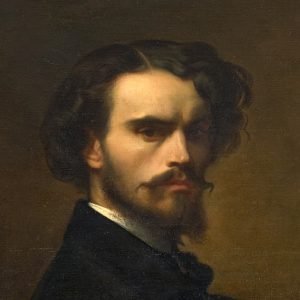
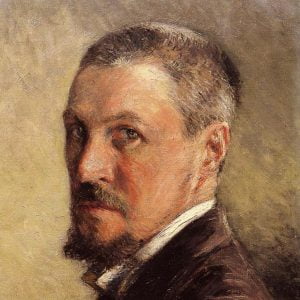
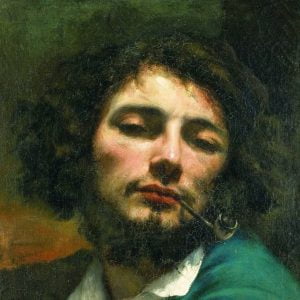
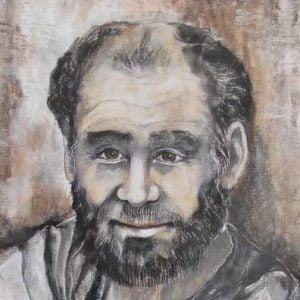
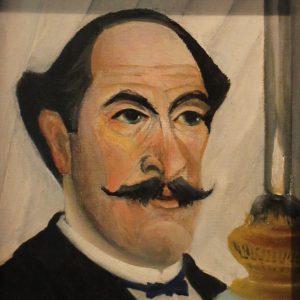
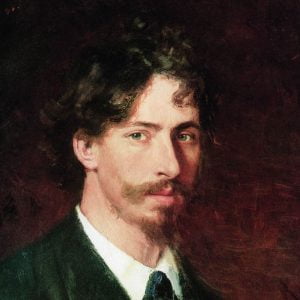
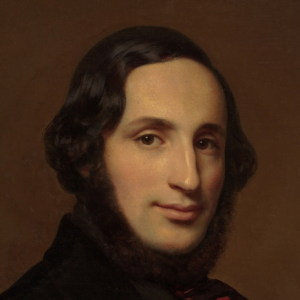
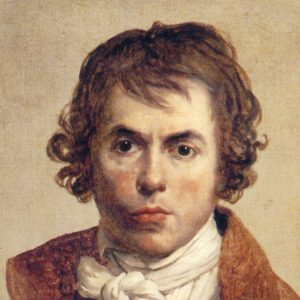
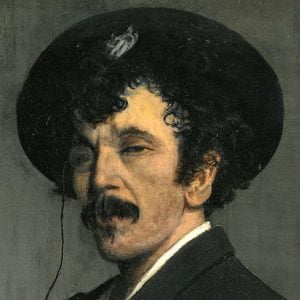
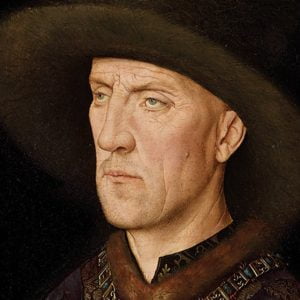
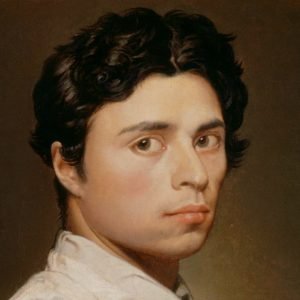
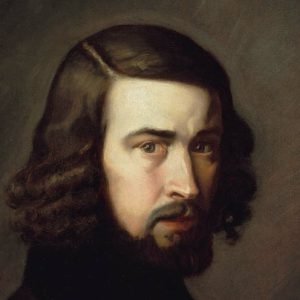
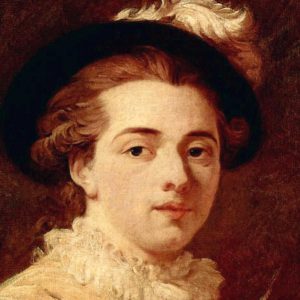
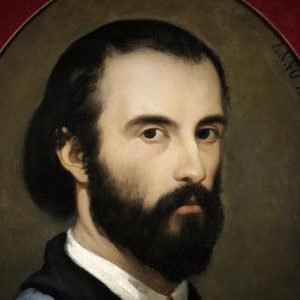
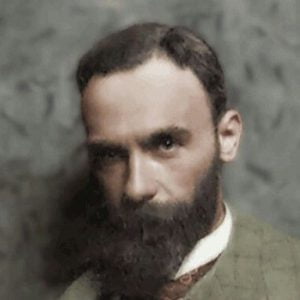
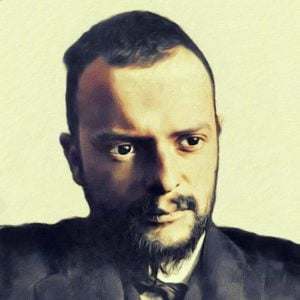
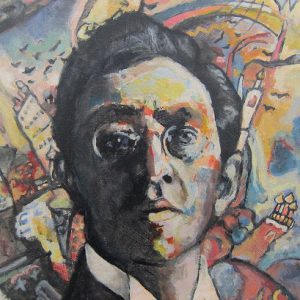

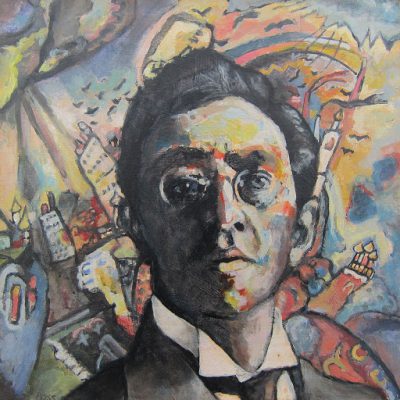
 Wassily Kandinsky (16 December by the Gregorian calendar) 1866 – 13 December 1944) was a Russian painter and art theorist.
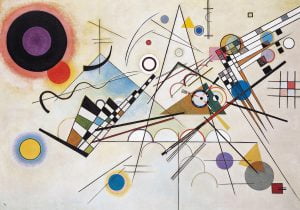
He is credited with painting one of the first recognised purely abstract works. Born in Moscow, Kandinsky spent his childhood in Odessa, where he graduated at Grekov Odessa Art school. He enrolled at the University of Moscow, studying law and economics. Successful in his profession—he was offered a professorship (chair of Roman Law) at the University of Dorpat—Kandinsky began painting studies (life-drawing, sketching and anatomy) at the age of 30.
In 1896, Kandinsky settled in Munich, studying first at Anton Ažbe’s private school and then at the Academy of Fine Arts. He returned to Moscow in 1914, after the outbreak of World War I. Kandinsky was unsympathetic to the official theories on art in Communist Moscow, and returned to Germany in 1920. There, he taught at the Bauhaus school of art and architecture from 1922 until the Nazis closed it in 1933. He then moved to France, where he lived for the rest of his life, becoming a French citizen in 1939 and producing some of his most prominent art. He died at Neuilly-sur-Seine in 1944.
Kandinsky’s creation of abstract work followed a long period of development and maturation of intense thought based on his artistic experiences. He called this devotion to inner beauty, fervor of spirit, and spiritual desire inner necessity; it was a central aspect of his art.
Kandinsky was born in Moscow, the son of Lidia Ticheeva and Vasily Silvestrovich Kandinsky, a tea merchant. His family comprised German aristocrats, and from his maternal side he also had Tatar origins, to which he ascribed the “slight Mongolian trait in his features”. Kandinsky learned from a variety of sources while in Moscow. He studied many fields while in school, including law and economics. Later in life, he would recall being fascinated and stimulated by colour as a child. His fascination with colour symbolism and psychology continued as he grew. In 1889, he was part of an ethnographic research group which travelled to the Vologda region north of Moscow. In Looks on the Past, he relates that the houses and churches were decorated with such shimmering colours that upon entering them, he felt that he was moving into a painting. This experience, and his study of the region’s folk art (particularly the use of bright colours on a dark background), was reflected in much of his early work. A few years later he first likened painting to composing music in the manner for which he would become noted, writing, “Colour is the keyboard, the eyes are the hammers, the soul is the piano with many strings. The artist is the hand which plays, touching one key or another, to cause vibrations in the soul”. Kandinsky was also the uncle of Russian-French philosopher Alexandre Kojève (1902-1968).
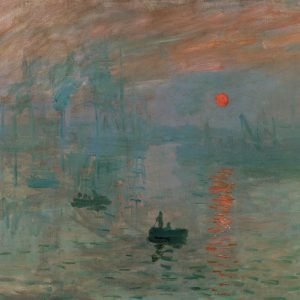
In 1896, at the age of 30, Kandinsky gave up a promising career teaching law and economics to enroll in the Munich Academy where his teachers would eventually include Franz von Stuck. He was not immediately granted admission, and began learning art on his own. That same year, before leaving Moscow, he saw an exhibit of paintings by Monet. He was particularly taken with the impressionistic style of Haystacks; this, to him, had a powerful sense of colour almost independent of the objects themselves. Later, he would write about this experience:
That it was a haystack the catalogue informed me. I could not recognize it. This non-recognition was painful to me. I considered that the painter had no right to paint indistinctly. I dully felt that the object of the painting was missing. And I noticed with surprise and confusion that the picture not only gripped me, but impressed itself ineradicably on my memory. Painting took on a fairy-tale power and splendour.
Kandinsky was similarly influenced during this period by Richard Wagner’s Lohengrin which, he felt, pushed the limits of music and melody beyond standard lyricism. He was also spiritually influenced by Madame Blavatsky (1831–1891), the best-known exponent of theosophy. Theosophical theory postulates that creation is a geometrical progression, beginning with a single point. The creative aspect of the form is expressed by a descending series of circles, triangles and squares. Kandinsky’s book Concerning the Spiritual In Art (1910) and Point and Line to Plane (1926) echoed this theosophical tenet. Illustrations by John Varley in Thought Forms (1901) influenced him visually.
In the summer of 1902, Kandinsky invited Gabriele Münter to join him at his summer painting classes just south of Munich in the Alps. She accepted, and their relationship became more personal than professional. Art school, usually considered difficult, was easy for Kandinsky. It was during this time that he began to emerge as an art theorist as well as a painter. The number of his existing paintings increased in the beginning of the 20th century; much remains of the landscapes and towns he painted, using broad swaths of colour and recognizable forms. For the most part, however, Kandinsky’s paintings did not feature any human figures; an exception is Sunday, Old Russia (1904), in which Kandinsky recreates a highly colourful (and fanciful) view of peasants and nobles in front of the walls of a town. Riding Couple (1907) depicts a man on horseback, holding a woman with tenderness and care as they ride past a Russian town with luminous walls across a river. The horse is muted while the leaves in the trees, the town, and the reflections in the river glisten with spots of colour and brightness. This work demonstrates the influence of pointillism in the way the depth of field is collapsed into a flat, luminescent surface. Fauvism is also apparent in these early works. Colours are used to express Kandinsky’s experience of subject matter, not to describe objective nature.