



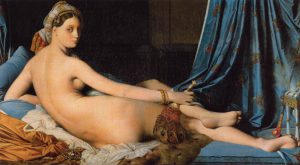
Jean Auguste Dominique Ingres
The Grand Odalisque by Jean Auguste Dominique Ingres 100% Hand Painted Oil Painting Reproduction
Jean-Auguste-Dominique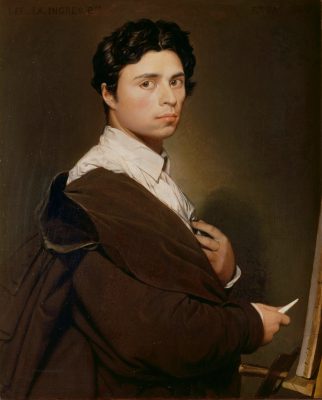 Ingres (29 August 1780 – 14 January 1867) was a French Neoclassical painter. Although he considered himself to be a painter of history in the tradition of Nicolas Poussin and Jacques-Louis David, by the end of his life it was Ingres’s portraits, both painted and drawn, that were recognized as his greatest legacy.
Ingres was profoundly informed by past artistic traditions, and in his career assumed the role of a guardian of academic orthodoxy against the ascendant Romantic style, exemplified by Eugène Delacroix. His expressive distortions of form and space make him an important precursor of modern art, whose work influenced Picasso and Matisse and other modernists.
Born into a modest family in Montauban, he travelled to Paris to study in the studio of David. In 1802 he made his Salon debut, and won the Prix de Rome for his painting The Ambassadors of Agamemnon in the tent of Achilles. By the time he departed in 1806 for his residency in Rome, his style—revealing his close study of Italian and Flemish Renaissance masters—was fully developed, and would change little for the rest of his life. While working in Rome and subsequently Florence from 1806 to 1824, he regularly sent paintings to the Paris Salon, where they were faulted by critics who found his style bizarre and archaic. He received few commissions during this period for the history paintings he aspired to paint, but was able to support himself and his wife as a portrait painter and draughtsman.
He finally achieved a great Salon success in 1824 with his Raphaelesque painting of the Vow of Louis XIII, and became recognized as the leader of the Neoclassical school in France. Although commissions for history paintings freed him to paint fewer portraits, it was his portrait of Louis-François Bertin that gave him his next popular success in 1833. The following year, his indignation at the harsh criticism of his ambitious composition The Martyrdom of Saint Symphorian caused him to return to Italy, where he assumed directorship of the French Academy in Rome in 1835. He returned to Paris for good in 1841. In his later years he painted new versions of many of his earlier compositions, a series of designs for stained glass windows, several important portraits of women, and The Turkish Bath, the last of his several Orientalist paintings of the female nude, which he finished at the age of 83.
Ingres was born in Montauban, Tarn-et-Garonne, France, the first of seven children (five of whom survived infancy) of Jean-Marie-Joseph Ingres (1755–1814) and his wife Anne Moulet (1758–1817). His father was a successful jack-of-all-trades in the arts, a painter of miniatures, sculptor, decorative stonemason, and amateur musician; his mother was the nearly illiterate daughter of a master wigmaker. From his father the young Ingres received early encouragement and instruction in drawing and music, and his first known drawing, a study after an antique cast, was made in 1789. Starting in 1786 he attended the local school École des Frères de l’Éducation Chrétienne, but his education was disrupted by the turmoil of the French Revolution, and the closing of the school in 1791 marked the end of his conventional education. The deficiency in his schooling would always remain for him a source of insecurity.
In 1791, Joseph Ingres took his son to Toulouse, where the young Jean-Auguste-Dominique was enrolled in the Académie Royale de Peinture, Sculpture et Architecture. There he studied under the sculptor Jean-Pierre Vigan, the landscape painter Jean Briant, and the neoclassical painter Guillaume-Joseph Roques. Roques’ veneration of Raphael was a decisive influence on the young artist. Ingres won prizes in several disciplines, such as composition, “figure and antique”, and life studies. His musical talent was developed under the tutelage of the violinist Lejeune, and from the ages of thirteen to sixteen he played second violin in the Orchestre du Capitole de Toulouse.
From an early age he was determined to be a history painter, which, in the hierarchy of artists established by the Royal Academy of Painting and Sculpture under Louis XIV, and continued well into the 19th Century, was considered the highest level of painting. He did not want to simply make portraits or illustrations of real life like his father; he wanted to represent the heroes of religion, history and mythology, to idealize them and show them in ways that explained their actions, rivaling the best works of literature and philosophy.
In March 1797, the Academy awarded Ingres first prize in drawing, and in August he traveled to Paris to study in the studio of Jacques-Louis David, France’s—and Europe’s—leading painter during the revolutionary period, in whose studio he remained for four years. Ingres followed his master’s neoclassical example. In 1797 David was working on his enormous masterpiece, The Intervention of the Sabine Women, and was gradually modifying his style away from Roman models of rigorous realism to the ideals of purity, virtue and simplicity in Greek art. One of the other students of David, Étienne-Jean Delécluze, who later became an art critic, described Ingres as a student.