
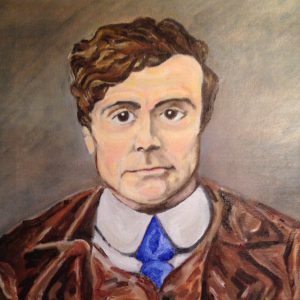
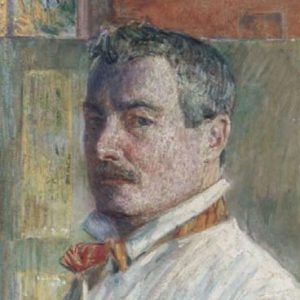
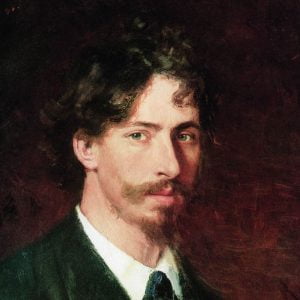
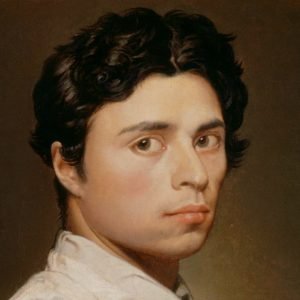
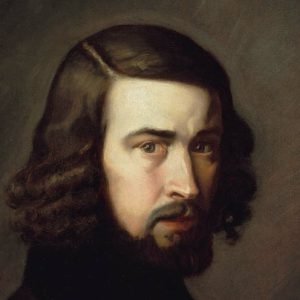
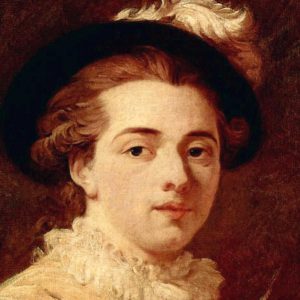
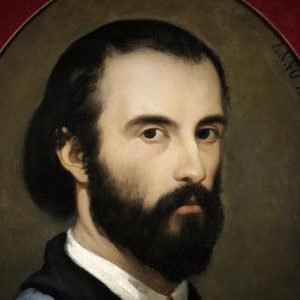
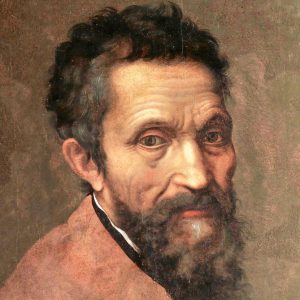
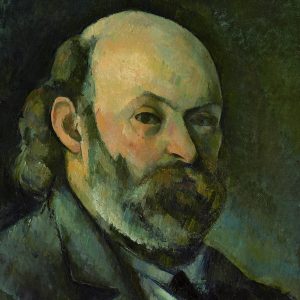
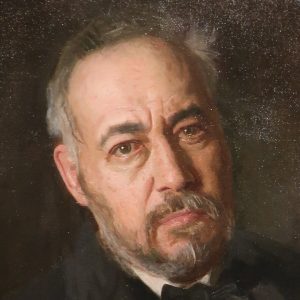

Thomas Cowperthwait 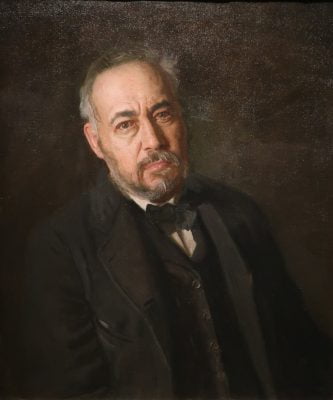 Eakins (July 25, 1844 – June 25, 1916) was an American realist painter, photographer, sculptor, and fine arts educator. He is widely acknowledged to be one of the most important artists in American art history.
For the length of his professional career, from the early 1870s until his health began to fail some 40 years later, Eakins worked exactingly from life, choosing as his subject the people of his hometown of Philadelphia. He painted several hundred portraits, usually of friends, family members, or prominent people in the arts, sciences, medicine, and clergy. Taken en masse, the portraits offer an overview of the intellectual life of Philadelphia in the late 19th and early 20th centuries; individually, they are incisive depictions of thinking persons.
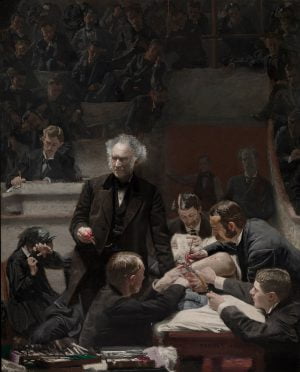
In addition, Eakins produced a number of large paintings which brought the portrait out of the drawing room and into the offices, streets, parks, rivers, arenas, and surgical amphitheaters of his city. These active outdoor venues allowed him to paint the subject which most inspired him: the nude or lightly clad figure in motion. In the process he could model the forms of the body in full sunlight, and create images of deep space utilizing his studies in perspective. Eakins also took a keen interest in the new technologies of motion photography, a field in which he is now seen as an innovator.
No less important in Eakins’ life was his work as a teacher. As an instructor he was a highly influential presence in American art. The difficulties which beset him as an artist seeking to paint the portrait and figure realistically were paralleled and even amplified in his career as an educator, where behavioral and sexual scandals truncated his success and damaged his reputation.
Eakins was a controversial figure whose work received little by way of official recognition during his lifetime. Since his death, he has been celebrated by American art historians as “the strongest, most profound realist in nineteenth- and early-twentieth-century American art”.
Eakins was born and lived most of his life in Philadelphia. He was the first child of Caroline Cowperthwait Eakins, a woman of English and Dutch descent, and Benjamin Eakins, a writing master and calligraphy teacher of Scots-Irish ancestry. Benjamin Eakins grew up on a farm in Valley Forge, Pennsylvania, the son of a weaver. He was successful in his chosen profession, and moved to Philadelphia in the early 1840s to raise his family. Thomas Eakins observed his father at work and by twelve demonstrated skill in precise line drawing, perspective, and the use of a grid to lay out a careful design, skills he later applied to his art.
He was an athletic child who enjoyed rowing, ice skating, swimming, wrestling, sailing, and gymnastics—activities he later painted and encouraged in his students. Eakins attended Central High School, the premier public school for applied science and arts in the city, where he excelled in mechanical drawing. He studied drawing and anatomy at the Pennsylvania Academy of the Fine Arts beginning in 1861, and attended courses in anatomy and dissection at Jefferson Medical College from 1864 to 65. For a while, he followed his father’s profession and was listed in city directories as a “writing teacher”. His scientific interest in the human body led him to consider becoming a surgeon.
Eakins then studied art in Europe from 1866 to 1870, notably in Paris with Jean-Léon Gérôme, being only the second American pupil of the French realist painter, famous as a master of Orientalism. He also attended the atelier of Léon Bonnat, a realist painter who emphasized anatomical preciseness, a method adapted by Eakins. While studying at the École des Beaux-Arts, he seems to have taken scant interest in the new Impressionist movement, nor was he impressed by what he perceived as the classical pretensions of the French Academy. A letter home to his father in 1868 made his aesthetic clear:
Already at age 24, “nudity and verity were linked with an unusual closeness in his mind.” Yet his desire for truthfulness was more expansive, and the letters home to Philadelphia reveal a passion for realism that included, but was not limited to, the study of the figure.
A trip to Spain for six months confirmed his admiration for the realism of artists such as Diego Velázquez and Jusepe de Ribera. In Seville in 1869 he painted Carmelita Requeña, a portrait of a seven-year-old gypsy dancer more freely and colorfully painted than his Paris studies. That same year he attempted his first large oil painting, A Street Scene in Seville, wherein he first dealt with the complications of a scene observed outside the studio. Although he failed to matriculate in a formal degree program and had showed no works in the European salons, Eakins succeeded in absorbing the techniques and methods of French and Spanish masters, and he began to formulate his artistic vision which he demonstrated in his first major painting upon his return to America. “I shall seek to achieve my broad effect from the very beginning”, he declared.