
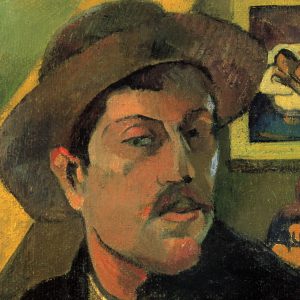
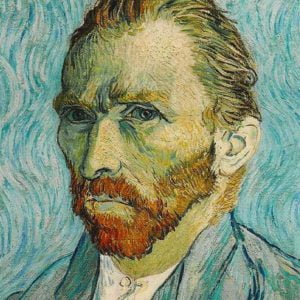

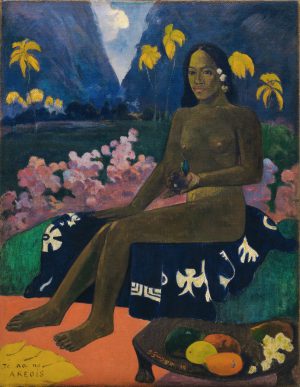
Eugène Henri 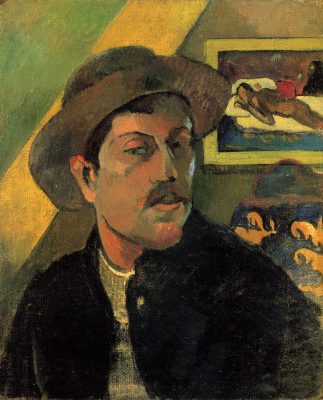 Paul Gauguin (7 June 1848 – 8 May 1903) was a French post-Impressionist artist. Underappreciated until after his death, Gauguin is now recognized for his experimental use of color and Synthetist style that were distinctly different from Impressionism. His work was influential to the French avant-garde and many modern artists, such as Pablo Picasso and Henri Matisse. Gauguin’s art became popular after his death, partially from the efforts of art dealer Ambroise Vollard, who organized exhibitions of his work late in his career, as well as assisting in organizing two important posthumous exhibitions in Paris. Many of his paintings were in the possession of Russian collector Sergei Shchukin and other important collections.
He was an important figure in the Symbolist movement as a painter, sculptor, printmaker, ceramist, and writer. His bold experimentation with color led directly to the Synthetist style of modern art, while his expression of the inherent meaning of the subjects in his paintings, under the influence of the cloisonnist style, paved the way to Primitivism and the return to the pastoral. He was also an influential proponent of wood engraving and woodcuts as art forms.
Gauguin was born in Paris, France to Clovis Gauguin and Alina Maria Chazal on June 7, 1848. His birth coincided with revolutionary upheavals throughout Europe that year. His father, a 34-year-old liberal journalist, came from a family of petit-bourgeoisie entrepreneurs residing in Orléans. He was compelled to flee France when the newspaper for which he wrote was suppressed by French authorities. Gauguin’s mother was the 22-year-old daughter of Andre Chazal, an engraver, and Flora Tristan, an author and activist in early socialist movements. Their union ended when Andre assaulted his wife Flora and was sentenced to prison for attempted murder.
Paul Gauguin’s maternal grandmother, Flora Tristan, was the illegitimate daughter of Thérèse Laisnay and Don Mariano de Tristan Moscoso. Details of Thérèse’s family background are not known; her father, Don Mariano, was a Spanish nobleman and an officer of the Dragoons. Members of the wealthy Tristan Moscoso family held powerful positions in Peru. Nonetheless, Don Mariano’s unexpected death plunged his mistress and daughter Flora into poverty. When Flora’s marriage with Andre failed, she petitioned for and obtained a small monetary settlement from her father’s Peruvian relatives. She sailed to Peru in hopes of enlarging her share of the Tristan Moscoso family fortune. This never materialized; but she successfully published a popular travelogue of her experiences in Peru which launched her literary career in 1838. An active supporter of early socialist societies, Gauguin’s maternal grandmother helped to lay the foundations for the 1848 revolutionary movements. Placed under surveillance by French police and suffering from overwork, she died in 1844. Her grandson Paul “idolized his grandmother, and kept copies of her books with him to the end of his life.”
In 1850, Clovis Gauguin departed for Peru with his wife Alina and young children in hopes of continuing his journalistic career under the auspices of his wife’s South American relations. He died of a heart attack en route, and Alina arrived in Peru a widow with the 18-month-old Paul and his 2 ½ year-old sister, Marie. Gauguin’s mother was welcomed by her paternal granduncle, whose son-in-law would shortly assume the presidency of Peru. To the age of six, Paul enjoyed a privileged upbringing, attended by nursemaids and servants. He retained a vivid memory of that period of his childhood which instilled “indelible impressions of Peru that haunted him the rest of his life.”
Gauguin’s idyllic childhood in this “tropical paradise” ended abruptly when his family mentors fell from political power during Peruvian civil conflicts in 1854. Aline returned to France with her children, leaving Paul with his paternal grandfather, Guillaume Gauguin, in Orleans. Deprived by the Peruvian Tristan Moscoso clan of a generous annuity arranged by her granduncle, Alina settled in Paris to work as a dressmaker.
After attending a couple of local schools, Gauguin was sent to the prestigious Catholic boarding school Petit Séminaire de La Chapelle-Saint-Mesmin. He spent three years at the school. At age fourteen, he entered the Loriol Institute in Paris, a naval preparatory school, before returning to Orléans to take his final year at the Lycée Jeanne D’Arc. Gauguin signed on as a pilot’s assistant in the merchant marine. Three years later, he joined the French navy in which he served for two years. His mother died on 7 July 1867, but he did not learn of it for several months until a letter from his sister Marie caught up with him in India.
In 1871, Gauguin returned to Paris where he secured a job as a stockbroker. A close family friend, Gustave Arosa, got him a job at the Paris Bourse; Gauguin was 23. He became a successful Parisian businessman and remained one for the next 11 years. In 1879 he was earning 30,000 francs a year (about $125,000 in 2008 US dollars) as a stockbroker, and as much again in his dealings in the art market. But in 1882 the Paris stock market crashed and the art market contracted. Gauguin’s earnings deteriorated sharply and he eventually decided to pursue painting full-time.