
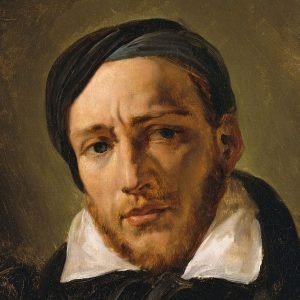

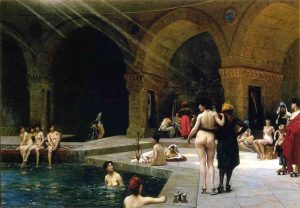
Jean-Leon Gerome
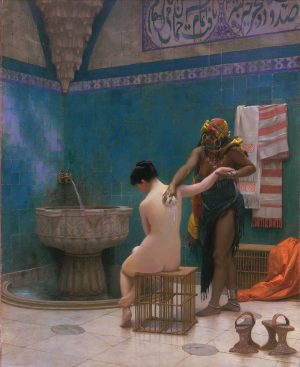
The Large Pool of Bursa by Jean-Leon Gerome 100% Hand Painted Oil Painting Reproduction
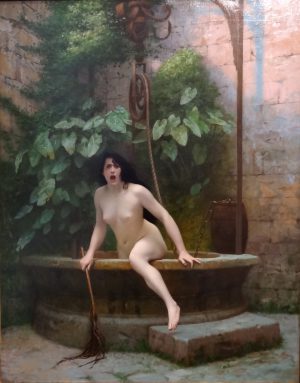
Jean-Leon Gerome
Truth Coming Out of Her Well by Jean-Leon Gerome 100% Hand Painted Oil Painting Reproduction
Jean-Leon Gerome
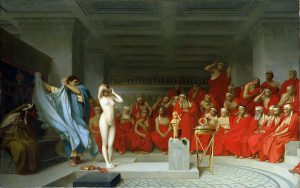
Phryne before the Areopagus by Jean-Leon Gerome 100% Hand Painted Oil Painting Reproduction
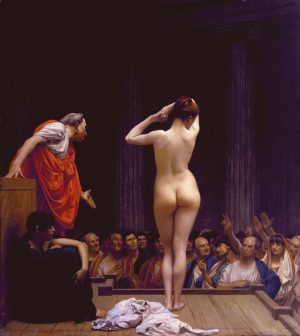
Jean-Leon Gerome
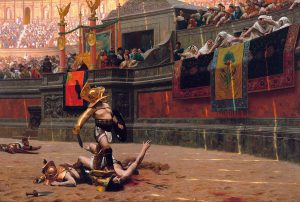
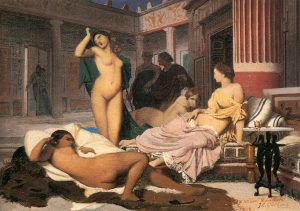
Selling Slaves in Rome by Jean-Leon Gerome 100% Hand Painted Oil Painting Reproduction
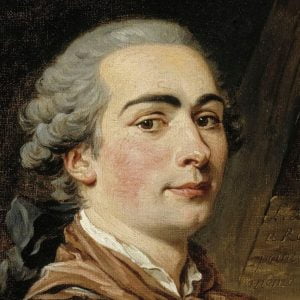
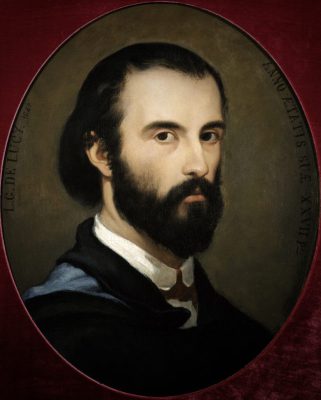 Jean-Leon Gerome (11 May 1824 – 10 January 1904) was a French painter and sculptor in the style now known as academicism. The range of his oeuvre included historical painting, Greek mythology, Orientalism, portraits, and other subjects, bringing the academic painting tradition to an artistic climax. He is considered one of the most important painters from this academic period. He was also a teacher with a long list of students.
Jean-Léon Gérôme was born at Vesoul, Haute-Saône. He went to Paris in 1840 where he studied under Paul Delaroche, whom he accompanied to Italy (1843–44). He visited Florence, Rome, the Vatican and Pompeii, but he was more attracted to the world of nature. Taken by a fever, he was forced to return to Paris in 1844. On his return, he followed, like many other students of Delaroche, into the atelier of Charles Gleyre and studied there for a brief time. He then attended the École des Beaux-Arts. In 1846 he tried to enter the prestigious Prix de Rome, but failed in the final stage because his figure drawing was inadequate.
His painting, The Cock Fight (1846), is an academic exercise, depicting a nude young man and a lightly draped young woman with two fighting cocks, the Bay of Naples in the background. He sent this painting to the Salon of 1847, where it gained him a third-class medal. This work was seen as the epitome of the Neo-Grec movement that had formed out of Gleyre’s studio (such as Henri-Pierre Picou (1824–1895) and Jean-Louis Hamon), and was championed by the influential French critic Théophile Gautier.
Gérôme abandoned his dream of winning the Prix de Rome and took advantage of his sudden success. His paintings The Virgin, the Infant Jesus and St John (private collection) and Anacreon, Bacchus and Cupid (Musée des Augustins, Toulouse, France) took a second-class medal in 1848. In 1849, he produced the paintings Michelangelo (also called In his studio) (now in private collection) and A portrait of a Lady (Musée Ingres, Montauban).
In 1851, he decorated a vase, later offered by Emperor Napoleon III of France to Prince Albert, now part of the Royal Collection at St. James’s Palace, London. He exhibited Bacchus and Love, Drunk, a Greek Interior and Souvenir d’Italie, in 1851; Paestum (1852); and An Idyll (1853).
In 1852, Gérôme received a commission by Alfred Emilien Comte de Nieuwerkerke, Surintendant des Beaux-Arts to the court of Napoleon III, for the painting of a large historical canvas, the Age of Augustus. In this canvas he combines the birth of Christ with conquered nations paying homage to Augustus. Thanks to a considerable down payment, he was able to travel in 1853 to Constantinople, together with the actor Edmond Got. This would be the first of several travels to the East: in 1854 he made another journey to Greece and Turkey and the shores of the Danube, where he was present at a concert of Russian conscripts, making music under the threat of a lash.
In 1853, Gérôme moved to the Boîte à Thé, a group of studios in the Rue Notre-Dame-des-Champs, Paris. This would become a meeting place for other artists, writers and actors. George Sand entertained in the small theatre of the studio the great artists of her time such as the composers Hector Berlioz, Johannes Brahms and Gioachino Rossini and the novelists Théophile Gautier and Ivan Turgenev.
In 1854, he completed another important commission of decorating the Chapel of St. Jerome in the church of St. Séverin in Paris. His Last communion of St. Jerome in this chapel reflects the influence of the school of Ingres on his religious works.
To the exhibition of 1855 he contributed a Pifferaro, a Shepherd, A Russian Concert, and The Age of Augustus, the Birth of Christ. The last was somewhat confused in effect, but in recognition of its consummate rendering the State purchased it. However the modest painting, A Russian Concert (also called Recreation in the Camp) was more appreciated than his huge canvases.
In 1856, he visited Egypt for the first time. Gérômes recurrent itinerary followed the classic grand tour of most occidental visitors to the Orient; up the nile to Cairo, across to Fayoum, then further up the Nile to Abu Simbel, then back to Cairo, across the Sinai Peninsula through Sinai and up the Wadi el-Araba to the Holy land, Jerusalem and finally Damascus. This would herald the start of many orientalist paintings depicting Arab religion, genre scenes and North African landscapes. In an autobiographical essay of 1878, Gérôme described how important oil sketched made on the spot were for him: “even when worn out after long marched under the bright sum, as soon as our camping spot was reached I got down to work with concentration. But Oh! How many things were left behind of which I carried only the memory away! And I prefer three touches of colour on a piece of canvas to the most vivid memory, but one had to continue on with some regret. He did not only gather themes, artefacts and costumes for his oriental scenes, but also made oil studies from nature for their backgrounds. Several of these quick sketches are filled with details that exceed his wished for three touches of colour.