
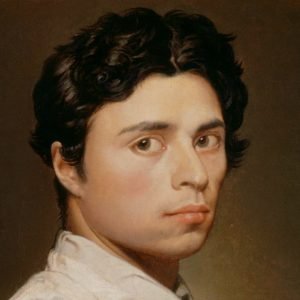
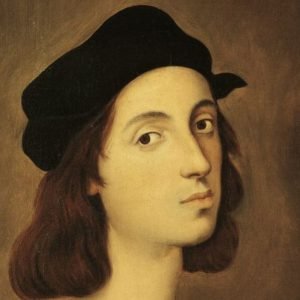

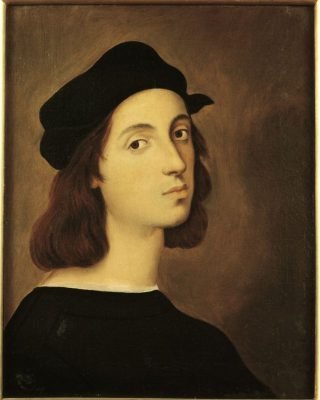
 Raffaello Sanzio da Urbino (March 28 or April 6, 1483 – April 6, 1520) known as Raphael, was an Italian painter and architect of the High Renaissance. His work is admired for its clarity of form, ease of composition, and visual achievement of the Neoplatonic ideal of human grandeur. Together with Michelangelo and Leonardo da Vinci, he forms the traditional trinity of great masters of that period.
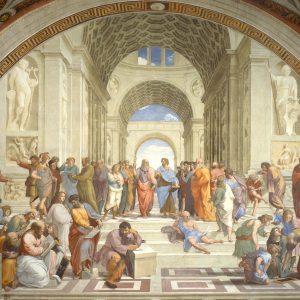
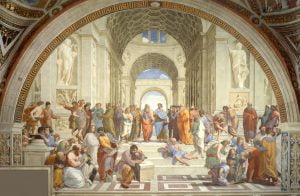
Raphael was enormously productive, running an unusually large workshop and, despite his early death at 37, leaving a large body of work. Many of his works are found in the Vatican Palace, where the frescoed Raphael Rooms were the central, and the largest, work of his career. The best known work is The School of Athens in the Vatican Stanza della Segnatura. After his early years in Rome, much of his work was executed by his workshop from his drawings, with considerable loss of quality. He was extremely influential in his lifetime, though outside Rome his work was mostly known from his collaborative printmaking.
After his death, the influence of his great rival Michelangelo was more widespread until the 18th and 19th centuries, when Raphael’s more serene and harmonious qualities were again regarded as the highest models. His career falls naturally into three phases and three styles, first described by Giorgio Vasari: his early years in Umbria, then a period of about four years (1504–1508) absorbing the artistic traditions of Florence, followed by his last hectic and triumphant twelve years in Rome, working for two Popes and their close associates.
Raphael was born in the small but artistically significant central Italian city of Urbino in the Marche region, where his father Giovanni Santi was court painter to the Duke. The reputation of the court had been established by Federico da Montefeltro, a highly successful condottiere who had been created Duke of Urbino by Pope Sixtus IV – Urbino formed part of the Papal States – and who died the year before Raphael was born. The emphasis of Federico’s court was more literary than artistic, but Giovanni Santi was a poet of sorts as well as a painter, and had written a rhymed chronicle of the life of Federico, and both wrote the texts and produced the decor for masque-like court entertainments. His poem to Federico shows him as keen to demonstrate awareness of the most advanced North Italian painters, and Early Netherlandish artists as well. In the very small court of Urbino he was probably more integrated into the central circle of the ruling family than most court painters.
Federico was succeeded by his son Guidobaldo da Montefeltro, who married Elisabetta Gonzaga, daughter of the ruler of Mantua, the most brilliant of the smaller Italian courts for both music and the visual arts. Under them, the court continued as a centre for literary culture. Growing up in the circle of this small court gave Raphael the excellent manners and social skills stressed by Vasari. Court life in Urbino at just after this period was to become set as the model of the virtues of the Italian humanist court through Baldassare Castiglione’s depiction of it in his classic work The Book of the Courtier, published in 1528. Castiglione moved to Urbino in 1504, when Raphael was no longer based there but frequently visited, and they became good friends. Raphael became close to other regular visitors to the court: Pietro Bibbiena and Pietro Bembo, both later cardinals, were already becoming well known as writers, and would later be in Rome during Raphael’s period there. Raphael mixed easily in the highest circles throughout his life, one of the factors that tended to give a misleading impression of effortlessness to his career. He did not receive a full humanistic education however; it is unclear how easily he read Latin.
From 1517 until his death, Raphael lived in the Palazzo Caprini, lying at the corner between piazza Scossacavalli and via Alessandrina in the Borgo, in rather grand style in a palace designed by Bramante. He never married, but in 1514 became engaged to Maria Bibbiena, Cardinal Medici Bibbiena’s niece; he seems to have been talked into this by his friend the cardinal, and his lack of enthusiasm seems to be shown by the marriage not having taken place before she died in 1520. He is said to have had many affairs, but a permanent fixture in his life in Rome was “La Fornarina”, Margherita Luti, the daughter of a baker (fornaro) named Francesco Luti from Siena who lived at Via del Governo Vecchio. He was made a “Groom of the Chamber” of the Pope, which gave him status at court and an additional income, and also a knight of the Papal Order of the Golden Spur. Vasari claims that he had toyed with the ambition of becoming a cardinal, perhaps after some encouragement from Leo, which also may account for his delaying his marriage.
Raphael died on Good Friday (April 6, 1520), which was possibly his 37th birthday. Vasari says that Raphael had also been born on a Good Friday, which in 1483 fell on March 28, and that the artist died from exhaustion brought on by unceasing romantic interests while he was working on the Loggia. Several other possibilities have been raised by later historians. In his acute illness, which lasted fifteen days, Raphael was composed enough to confess his sins, receive the last rites, and put his affairs in order. He dictated his will, in which he left sufficient funds for his mistress’s care, entrusted to his loyal servant Baviera, and left most of his studio contents to Giulio Romano and Penni. At his request, Raphael was buried in the Pantheon.
Raphael’s funeral was extremely grand, attended by large crowds. According to a journal by Paris de Grassis,[g] four cardinals dressed in purple carried his body, the hand of which was kissed by the Pope. The inscription in Raphael’s marble sarcophagus, an elegiac distich written by Pietro Bembo, reads: “Here lies that famous Raphael by whom Nature feared to be conquered while he lived, and when he was dying, feared herself to die.”